A Word or Two...
  • Blog
  • About
  • Contact
  • All Kids Can Write

I choose joy...

12/30/2019

 
Picture
I choose joy! Joy will be my one-word going into 2020!

Last year, my word was "lightening", and all year long I dedicated my energy to lightening the work world around me through my job as a literacy support specialist. I spent my year training teacher teams, supporting teachers and administrators, serving students in my district, designing curriculum, following leaders. To borrow a quote, ​It was the best of times. It was the worst of times. The model was not working. Too much of my brain space was scattered in small pieces across too many challenges that could not and would not be lightened by my efforts.   No. Matter. How. Hard. I. Tried.

Fast forward to today. This morning I went out for a long walk. I could not run because my right knee is not feeling great and I'm wary of seriously injuring it. So, there I was, walking at a fast pace (no knee pain) and feeling surprisingly joyful. Not being able to run usually irritates me. I am a slow jogger, but I am dedicated to and dependent on those amazing endorphins that cheer the rest of my day after a morning run. I can count on one hand the number of runs in my life that have been easy. I started running late in life, and it usually feels less of a run and more of a workout. That's fine!! I love the sweaty, accomplished feeling that fills me up after my version of a run. Slow or not. Jog or run. 4 miles per hour or 5. Never matters. As long as the action was running and not walking.

So, why was I feeling so joyful this morning?

I have realized that the effort that is required during my runs, those workouts, taps into my cognitive energy as well. In other words, when I'm running, I'm so focused on breath, legs, distance, time, etc., that I don't have the capacity to think, wonder, ponder, plan,...enjoy. Kicking back my run to a fast walk has given me the brain space to think, wonder, ponder, plan,...enjoy the world around me as I go. I can watch the sun color the sky behind clouds as it rises. I can slow dow so as not to scare the deer or rabbits hanging out by the trails. I can listen for the eagle's cry and search the treetops for a glimpse. Walking gives me the space to fill up my soul with joy.

The same joy is present now everyday when I go to work. Kicking back  to the classroom has given me the brain space, and heart space, to love what I do again. My days are filled with all the space I need to feel joy - the joy of teaching my twenty-one students, the joy of working with a brilliant and generous team, the joy of following leaders with vision who care about me, the joy of being in a community full of support and kindness. Teaching gives me the space to fill up my soul with joy.

What might have seemed like a step back has proved to be a blessed leap forward in my journey - as an educator and as a human being. I will choose joy this year. In everything I do. And I know that choosing joy is not always easy or intuitive depending on the circumstances. But, when soul recognizes passion, and passion finds expression, and brain and heart space both exist for passionate expression to build and grow, joy abounds.

Happy New Year! May you find joy in all that you do in 2020!

#allkidscanwrite

Putting the crown away for good...

12/21/2019

 
Picture
Ahhh, winter break. You have rescued me right when I knew I could not go on much longer. Oh, no. It is not the students from whom I needed to be rescued. Those precious, joyful children are the reason I am still standing at all. No. It is the physical, mental, emotional, logistical weight of teaching that has collectively pressed down upon my psyche until this body just about gave out. Laryngitis and a relentless cold during the last week before a holiday has been brutal. But, lovely winter break, you got here. You got here just in time!

My return to the classroom after 7 years and at 59 years old has been full of surprises - some good and some not so good. When I interviewed for the position last spring, I mentioned my intent to infuse a coaching stance into my teaching rather than to continue using the more teacher-directed, "leader of the classroom" approach I had perfected in my previous experiences. I mean, really, when I first began teaching, I felt like I was the queen of my own little kingdom. I made and enforced the rules. I wrote the lessons. I delivered the lessons. I taught, students learned. That was my algorithm. And, it worked. Or, so I thought.

And then I started reading about coaching. I took a class. I became a certified Evocative Coach. Just think about the word evocative. It means tending to evoke. And evoke means  to elicit or draw forth (https://www.dictionary.com/browse/evoke). In working with teachers, the evocative coach encourages the teacher to consider her practice through guided conversations.  The coach draws out the teacher's own thinking and decision-making without making recommendations or using any evaluative criteria in the process. It is supposed to be a 100% coachee-directed experience, with the coachee controlling her own learning/growing.

When I was a literacy coach for my district, this was not the model that we used. My job was much more geared to going into buildings and classrooms and working with teachers and teams on district and state level initiatives. While I still tried to use a side-by-side coaching stance, I often was more of a trainer and less of an evocative coach. To be sure, evocative coaching is an asset-based model that can require time (and patience), not the support-specialist approach that is more directed and quicker. 

Flash forward to my interview and my new job. The good, and the not so good.

As I sat in front of 21 little ones those first few weeks of school, I realized that I was no longer going to be the queen of the kingdom. As I watched their minds and bodies grapple with being in school - sitting in chairs, trying to maintain criss-cross applesauce on the carpet, lining up for transitions, moving through hallways, playing on the playground - I knew that I was going to need to be their coach, not their queen. It was not going to be any good to keep repeating, "Little one, please stop squirming. Little one, your constantly moving legs need to stop. Little one, stop calling out and raise your hand (for the 100th time!). Trust me. I tried. And then I realized that these little ones were doing the best they could at being themselves. And while, of course, my job is to provide instruction in curriculum and behaviors, until those little ones are able to recognize and manage their "practice" as students in a school environment, I need to continue to evoke their good decision-making and self-reflection skills.

And that, my readers, takes a physical, mental, emotional, and logistical toll. A huge one. It was much easier to be the queen. Putting my own practice to the test, holding myself to the same standards I had been training teachers to use, was and continues to be humbling. I am forging my own idea of what it means to allow the students to drive their own learning. And it is challenging and exhausting. And I am so far from good at it. 

But, as I coach myself, I remember that self-reflection is key. I have decided on certain instructional and pedagogical goals to move my practice to be more student-driven and less teacher-directed.

And, just as I accept my students where they are academically and behaviorally. I need to be as accepting of myself as I learn how to put the crown away for good.

Happy Holidays!

#allkidscanwrite


Perfect vs. Present...

8/12/2019

 
Picture
With the long days of summer now being measured, I have been spending time planning units and lessons for the first week or two of school. Anyone who knows me knows that I am quite possibly compulsive about being prepared before I teach/present/lead/etc. I still write out my lesson plans, a practice one former colleague called "old school". Well, if spending time identifying objectives and learning intentions, searching for relevant materials, defining student success criteria, planning think-alouds, considering student engagement, embedding opportunities for inquiry, and MORE, all while keeping assessment in mind from the very beginning is "old school", then I'm that teacher. I couldn't do this any other way. I really do love to plan lessons!

But, I am beginning to feel the pressure of the waning days of summer creep across my shoulders. It has been downright fun to sit at my desk in my Florida room, watching the shenanigans of the critters in my backyard as I sift through mentor texts, designing lessons  for shared reading.   And then doing the same for math and social studies just to round out the first week's curriculum. Up until now, time has been my friend. Time has allowed me to work the way I like, creating lessons that will engage my students, invite inquiry, and grow their understanding of the curriculum.

The perfectionist in me insists on creating these lessons within a framework that is different than when I left the classroom 7 years ago. You heard me say the words engagement, inquiry, design...all concepts that have been added to the landscape of pedagogy through the works of literacy giants like John Hattie and Harvey "Smokey" Daniels, among many, many others. My teaching practice is strongly influenced by current thinking in literacy. I have read the books, studied the research, and am trying to capture all of the resulting "best practices" in my lessons. Every single one of them. 

And time is running out.

​I took a picture on my run this morning of the sun, rising behind a stand of trees at the reservoir. I could just see the shine of the sun glinting between and behind the full leaves of the trees.
​


Picture
In my mind, the sun represents the perfect lesson - one that includes best practices and serves students in the best and most engaging ways. But in order to get to that lesson, I have to find my way through the limbs and branches and leaves on the trees, representing the pedagogy, the materials, and all of the components of lessons that need to be considered and included. I know that the lesson is back there, illuminating and energizing for students. But, oh, the density of resources and depth of thinking that must be moved through to reach the lesson takes a lot of time!

So, how do we as teachers find our way to that lesson when time is no longer abundant?

I'm not sure I know the answer. One thing I do know to be true...I have to let go of the idea of perfect. There is no perfect lesson. There is no perfect teacher. There are no perfect classrooms. Chasing perfection is exhausting.

What is necessary and what I can be is perfectly present. I am releasing myself from having a perfect classroom set up before my students even step foot through the door. I am releasing myself from writing perfect lesson plans for every subject for every day of every week. I am releasing myself from thinking I have to be a perfect teacher because I have 20 years of experience. 

What I will expect from myself is to be perfectly present. Present for my students. Present for their parents. Present for my colleagues.

You can see the brightening sky above the trees in my picture. The sky is always present, even when the sun is hidden.  I will aim for the brightening sky 100% of the time, and hope to find the sun when I can. 

Have a great week! 

​#allkidscanwrite


A Funny Thing Happened at the Office...

7/24/2019

 
Picture

​This September, Back to School  takes on a deeper meaning for me. My job as a district literacy coach was eliminated last spring, resulting in my having to make a choice. I could move to a newly created and offered position for which I feared I was not qualified, or I could apply for a classroom teaching position in one of our elementary schools. I did not have to deliberate for long! Not only was it impossible for me to sign onto a job for which I did not have the requisite skills set, I was overjoyed to even consider heading back into a classroom of my own. 

This summer has been one of lingering grief over the loss of my coaching position - one for which I studied and trained and gave my all for the administrators, teachers, and students I served.  But it has also been one of eager anticipation. Seven years after I left my last class of first grade students (4 years as a reading specialist, then 3 years as a literacy coach), I am blessed to begin anew with another class of sweet firsties! 

I am discovering what a strange juxtaposition now exists for me. Most of my age peers are retired or retiring! And, yet, here I am going into the classroom and feeling like a newbie! What a strange confluence of knowledge and ignorance. The classroom of today is vastly different than the classroom of even seven years ago. Technology, social and emotional learning, instructional pedagogies, and even the curriculum to be taught, have redesigned the classroom landscape. And here I am - a National Board Certified teacher, with a master's degree and two endorsements (gifted and reading specialist), going back into a classroom and feeling brand new.

Happily, I am choosing an attitude of positivity and building my own growth mindset. For the first time in seven years, I will be asked to implement all of the research-based practices I have been asking others to embrace in my position as a coach. I will be called upon to constantly ask myself, Is this best for students? just like I have been asking others to do. I will be called upon to assess and document my students' learning and to use  that information with intention and purpose to further their learning, and to share that information with parents, administrators, and my team just like the hundreds of teachers I have coached across the last three years.

I pledge to be transparent about my experiences. There are sure to be some surprises and challenges ahead for me as a "new" instructor 20+ years after I taught my first class of students. 

At the end of the day, I am honored, grateful, and humbled to be heading back to a  classroom of children to teach, a team of amazing educators to partner with, and a school community to embrace.

Most of all, I will be teaching writing again. My heart is full of joy. 

Have a wonderful week, and remember, #allkidscanwrite!
Choice and the Hamburger Steak Incident...

9/30/2018

 
Picture
"I am who I am today because of choices I made yesterday." Eleanor Roosevelt.

Choice. The choices we make as people everyday determine who we will become tomorrow. And, the choices we make as writers at the outset of our work, influence what our work will become through the process.

Choice. One of the most important ingredients necessary for writers to be fully engaged in their work. Choice suggests intention, decision-making, and purposeful craft...this trio of mindful thinking empowers our students to take ownership of and care deeply about their writing.

This week, as I considered my story, I wondered about whether I should quickwrite the story on lined paper first, or just begin drafting it in my blank picture book.  I know that I am a planner, so my choice as a writer was to first begin drafting my story in text, sentence by sentence, in my writer's notebook. In this way, I could capture everything I could remember about the hamburger steak story in words before I try to pace it out across my picture book and add illustrations.

You have the same choice! Which approach best suits your style? Some writers prefer to sketch out a story before adding actual text. Sketching allows the writer's mind to see and visibly record the content of the story. And that is a terrific instructional approach with your students - all students - not just your primary kiddos. Other writers prefer to quickdraft, writing down everything about their stories in their notebooks before beginning to craft a product.

So, here is my quickdraft. As you read it, keep in mind that I am at this point simply trying to capture every detail that I can remember from that moment. (Deep Dive #5 Writers write down their stories fast and furious) This is not a draft to be scored for grammar, spelling, composition, etc. This is getting as much of my story down on paper before I start crafting it as a narrative piece.

Picture
As an adult sharing this story of my youth, I feel like I need to clarify for you all that I am/was an extreme rule-follower. So, this incident truly dramatizes the extent to which I did not want or was not capable of eating that hamburger steak!! Interestingly, I grew up to be a vegetarian. Every story is worth telling!

Looking at this draft using a lens of possible instructional guidance for the writer (me), I will need to address the following tenets of narrative writing that we considered in one of our ToeDips:  
  • Don't forget the dialogue! People in stories talk. When you are telling your story, try to remember what was said (or you can embellish since you might not remember exact words.) I did not recreate actual dialogue, although I referenced what characters said.
  • Avoid the passive voice and describe the action and events as if you were making a movie in your mind. (Some parts of my draft are told in this active voice, some are not).
  • Things happen in a beginning, middle, and end sequence - and there needs to be balance between the three story parts. The ending of my story is too abrupt.
So, how did it go for you this week? Did you choose a seed story from your list of small moments? Did you write or draw (or both) your story in a fast and furious way so that you could capture every detail that you can remember?

Read through your draft using an instructional lens. Does your story have action? Is it told using an active voice that engages the readers? Do your characters talk? Is there actual dialogue? How balanced are your beginning, middle, and end? Next time I will begin sharing specific lessons that address these narrative components.

Keep writing, teachers! I would love to hear your stories, so please share them here or you can email them to me ([email protected]). Bravo to you for working through the same process that you ask your students to undertake. It builds empathy and strengthens your teaching. You are making the powerful choice to engage with writing and to build your own capacity as a writer.

Have a great writing week!

#allkidscanwrite
#allteacherscanwrite
​

Summoning Our Artistry...

9/16/2018

 
Picture
Picasso said, "Every child is an artist. The problem is how to remain an artist when he grows up." How many of us can relate to this loss of artistry as we grew up? As children, we tended to have less external constraints on our creativity. Things like time and the responsibilities of adulthood had not yet chipped away at our ability to sit quietly with our art and nurture its growth.

As adults, when we think about being writers in our classrooms or in our lives, we need to summon the artistry of our childhood back to our conscious minds. I am defining artistry here as creativity in any form, not just in writing. That ability to conceive of and express feeling and voice in ways that others can see and share.

Without fear.

So, let's keep moving with our picture books! Let's not be afraid to share our stories orally and on paper. Let's summon the creativity of our child-selves and write!  Today, we are ready to choose a seed story that we will develop into our picture book.

Choosing A Seed Story - Telling Our Stories Out Loud and On Paper

Deep Dives
  •  Deep Dive#3 - Writers choose the story that they remember the best to draft into a picture book.  When we write personal narratives, we want to bring readers into our stories, as if they are right there with us in the moment. To do that well, we must include lots of detail so that the reader feels immersed in our world. So, try to choose the story idea that you remember the best, with the most detail. Clear memories provide rich details that make our stories strong.
    • ToeDip - Choosing a story that has meaning. Not all stories are equal. Sometimes we can't recall enough detail about a story to be able to write it well. Or, we might remember lots of details about another story, but we don't feel emotionally connected to it. Try to choose a small moment that you both remember well and that was important to you. By choosing that moment, you will be able to capture and convey the heart of the story for your reader.
      • Think about each of your three small moments and consider which one you remember best.
        • Which moment do you remember with the clearest detail?
        • Which moment carries the most meaning for you?
        • Which moment do you feel eager to share with a reader?
  • Deep Dive#4 - Writers tell their stories to others first. It may seem counterintuitive, but writing is a very social interaction. The writer is engaging with a reader, and vice versa, not simply putting words down on paper. The process begins when a writer tells his story out loud to someone. Storytelling is the first step in capturing and conveying the details, the tone, the voice, and the scope of a story. And, the more often the writer tells his story, the more solid the story becomes, each oral version building upon the one before.
    • ToeDip - Storytelling 
      • ​You can tell your story in beginning, middle, and end chunks. By dividing your story into three parts, you can really think about what happened first, next, and last.
      • Don't forget the dialogue! People in stories talk! When you are telling your story, try to remember what was said (or you can write what was probably said since you might not remember exact words).
      • Avoid using a passive voice, but rather describe the action and events as if you were making a movie in your  mind. Telling your story using an active voice will engage your listener and help her feel as if she is right there in the moment with you.
  • Deep Dive#5 - Writers write down their stories fast and furious. Once writers have told their stories out loud a few times, they can move to a clean piece of paper and write the story of the small moment, capturing every single detail that they included in the oral version of the story. The idea is to write fast and furious, not worrying at all about grammar and conventions at this point. This is the time for writers to move the small moment story, all of it, to paper.
    • ToeDip - Writing Fast and Furious. It is very important that you write for more than a few minutes. Writing is thinking work, and we have to build writing muscles in order to write well. As soon as you think you are finished, ask yourself, "What else?" and keep going.
      • Move to a clean piece of paper and write down the story of your small moment.
      • Write fast and furious - keep writing down everything you remember about that moment.
      • When you think you're done, keep going. You will be surprised what other details appear as your pen continues to move across the paper.

As I look over the three small moment stories I wrote down in my sketchbook, I decide to choose the "Me vs. the Hamburger Steak" story. The nagging adult voice in my head is saying that this is not much of a story, inconsequential and silly. That voice is trying to convince me that no one, anywhere, would want to read about the hamburger steak debacle. But, I am not going to listen to the adult voice in my head. I am going to summon my childlike sense of artistry and feel brave enough to tell this story. I will not be afraid to try.

If you are feeling any discomfort as you go through this process, remember that feeling when you are asking your students to do this same work. Aside from being important to your own writing self, making this picture book will build empathy in you for all of the young writers who are struggling. While  creativity still dances in their hearts, young writers need our empathetic guidance to keep self-doubt away as long as possible! Every single story has value.

I'm going to be working on my story this week. Maybe we can share our stories with each other next time!

Have a great writing week!

#allkidscanwrite
#allteacherscanwrite


LOVE for Everything Writing!

9/2/2018

 
Picture

According to author and psychiatrist Elisabeth Kubler-Ross "There are only two emotions: love and fear. All positive emotions come from love, all negative emotions from fear." She also believed that these two emotions are mutually exclusive, that we cannot live in a state of fear and love at the same time. 

Is it possible, as suggested by Kubler-Ross's theory, that all of the negative energy that flows around writing instruction in our classrooms may actually stem from fear?

Whoa!   What?    Hold on a minute!

Let's flip this thinking around right now and, instead, consider how we might create positive energy around writing instruction in our classrooms by learning to LOVE the process, LOVE the product, and LOVE the community that grows when everyone is a writer! 

As an elementary literacy support specialist in my district, I conduct a lot of professional learning sessions in August. One line that I uttered at many of these sessions got a big laugh every single time - "You only have to be a little bit better writer than your students." When I said this, teachers could breathe, relax, and let go of the fear of not being confident as writing teachers. They smiled, looked at each other, and I could practically see the negative energy leave the room.

Love conquers Fear! 

Remember last time I talked about making picture books? Let's begin to build our love for everything writing by authoring a picture book. This genre is appropriate to teach writing to all levels of students because all children are familiar with the structure of a picture book. And, so are all teachers! We can call on this very familiar context to be the foundation for our first writing experience, much like we do for our pre-K and kindergarten students.

I'm using the analogy of swimming for our writing lessons. Being comfortable in any body of water is scary for lots of people; and water has a metaphorical vibe for being an "unknown". So, we will start with what I call Deep Dives. These are the simple truths about what we are learning. We anchor all of the strategies of writing on the Deep Dives. 

Generating Ideas - The "I Don't Have Anything To Write About" Fear

Deep Dives:
​
  1. Deep Dive#1 Writing is storytelling:  When we write personal narratives, we are telling stories about our lives. Let's think about story.
    • Things happen -
      • Action/Events
    • There are characters -
      • Who say things.
      • Who do things.
    • Things happen in sequence -
      • Beginning
      • Middle
      • End
  2. Deep Dive #2 Writers get ideas from their own lives:  Writers get ideas from their own lives,
    • BUT, sometimes writers have a hard time thinking of ideas,
    • SO, we read books to spark ideas. 
      • Mentor texts can give us a jumping off point, inspiring us to consider something that happened in our lives that could be interesting to a reader.
Next, are the ToeDips. ToeDips are the instructional practices I want you to try. Going back to our swimming analogy, before anyone jumps into a pool for the first time, they most likely stick their big toe in for a temperature check. To me, ToeDips represent the first, safe step in what can be an unknown situation. 
  1. ToeDip - Thinking of Ideas​
    • Read Fireflies!, by Julie Brinkloe (or find it read aloud on YouTube if you don't have a copy on hand) and
      • Think about the specific kinds of things you did when you were a kid, like catching fireflies in the evening.
      • Remember those small moments of your childhood that were part of how you grew up.
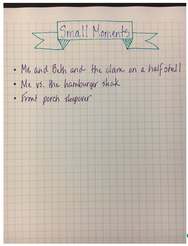
      • Take out your sketchbook/writer's notebook and turn to a clean page. Make a list of at least 3 small moments in your childhood that you can remember with some detail.
​         (ToeDipTip:  Small moments are usually stories about things that happen in a short amount of time, small snapshots of time in which something happens. They are not big stories that cross large amounts of time.)​​

Picture
My sketchbook with 3 small moment ideas listed.
There! That's a wonderful start. I hope you can feel the joy  of remembering small moments from your childhood. We have to train ourselves to believe that we, too, have stories to tell. That no memory is insignificant. That all of our stories have value and should be shared. If we want our students to believe this, we have to believe it in our own hearts as well!

Next time, we will think about which of our small moments we want to expand into a full narrative. I want to thank Lucy Calkins and all of the great work that has come out of Teachers College at Columbia University for the foundational thinking I am sharing with you. She inspired my love of writing, love that replaced fear, which has, in turn, inspired hundreds of my students to love writing as well.

I hope you are inspired to love writing, too! Have a great writing week! 

#allkidscanwrite
#allteacherscanwrite

Who Wants to Make a Picture Book?

8/12/2018

 
Picture
Who wants to make a picture book? Seriously. Who would like to join me in composing a story in picture book form, using the language of the writing process and encompassing all of the components of personal narrative structure?

I mean, think about it. We begin teaching the writing process in kindergarten - using picture books! Katie Wood Ray showed us the efficacy of using a picture book structure with our youngest writers. Those little ones intuitively understand picture books because they've seen and heard them read aloud, they "know how picture books go". And so the writing work becomes centered around story composition and illustrations that support words in a context that is familiar and "safe". As pages are turned, the story unfolds in an organic beginning-middle-and-ending way. And, as those little ones draw and write and turn the pages of their picture books, their teachers teach mini-lessons that seamlessly build understanding of process and product. 

It has occurred to me that this very organic approach to teaching writing in kindergarten might appeal to teachers who have low confidence in their writing abilities, who fear writing in front of their students, whose self-efficacy as writers does not exist. Especially if it is seen as a relaxed, enjoyable form of writing - no pressure, just opportunity for self-expression with a few mini-lessons tucked in to build real writing capacity. 

In my heart of hearts, I know that teachers must be writers if they are to be successful writing instructors. I can't think of one other subject that teachers teach without being able to successfully engage in the content before they instruct students. As educators, we need to be fully present in "practice", not bystanders teaching from the sidelines. 

And, most importantly, in my heart of hearts, I know that every single teacher, just like every single student can learn to write! 

Who's in? Check back next week and we'll get started! 

#allkidscanwrite
#allteacherscanwrite

Happy Writing!!

Graphic Narrative Writing...

3/17/2018

 
Picture

How popular are graphic novels in your classroom? I walked into a third grade classroom last week and every single student was nose deep into a graphic novel! The dynamic pictures, lively dialogue, and graphic structure seem to be giving readers access to stories (adventures, mysteries, humor, historical fiction, etc.) in an engaging way that satisfies their reading appetites. 

I first became intrigued with this reading genre when I was a Literacy Specialist. Every Friday in my classroom was Flashlight Reading Day; students spread out across the room -  sprawled on beanbag chairs, curled up on comfy rugs, or tucked into dark niches - and read. By flashlight. They loved it! As the students read, I called each over, one by one, for a reading conference. I learned so much about my struggling readers through those reading conferences. And, I began to notice that my upper elementary boys, especially, were more and more often bringing graphic novels to my table.

And that's when I started thinking about writing...If reading graphic novels was engaging and accessible to struggling readers, would writing graphic novels offer the same level of engagement and accessibility to struggling writers? Or, for that matter, to all writers?

I have spent the last three years writing and revising a Graphic Narrative Unit of Study for primary writers. I've used it with first and second graders, and I've presented it to teachers in my state at our last two Virginia State Reading Association conferences. I published an article on the first year's work on Heinemann's Digital Campus entitled "Where Storytelling Meets Art Writing Graphic Narratives with First Grade Students", and I'm looking forward to presenting this work at the International Literacy Association's annual conference in Austin, TX on July 21st! 

I'm searching for teachers who want to try this kind of writing with their students. I'm trying to spark a new fire for engaging students in the writing process. When I talk to teachers, I want to feel the urgency that exists for meeting students where they are as writers and for propelling them forward. I want to help them capitalize on current reading trends and show their reluctant writers a new and relevant way to find and share their voices.

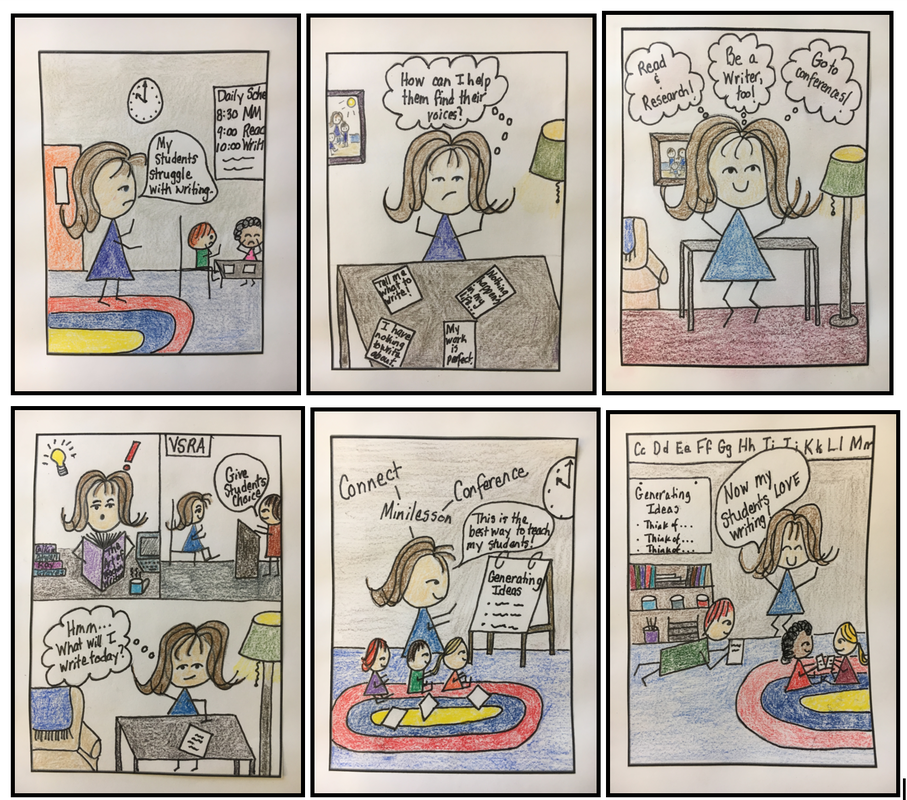
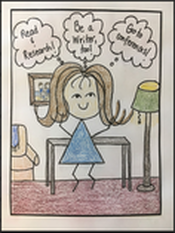
Below is my own graphic narrative depicting my journey as a writing teacher. I have to say, drawing and coloring my story has been a reflective process. I followed the same process that I ask my students to use when they write their graphic narratives. It turns out that you really don't have to be an "artist" to be a successful graphic narrative writer. And, as I've said again and again, "If I can do it, YOU can do it!"  

I'd love to hear from you if you are interested in trying this with your students. You can always leave a message here, or you can reach me through Twitter @christyweisiger, or email [email protected]. I'm also on Facebook at All Kids Can Write.

Picture

Have a great writing week!

#allkidscanwrite

Pressing on With Passion...

1/28/2018

 
Picture


The disruptions of wintertime too often derail even the best laid plans, and this winter is throwing snow at  all of us,  taunting us with icy interruptions and threatening the consistency of our instruction. But, remember, your writers take their cue from you. If you continue to infuse energy and excitement into the delivery of your lessons and across your interactions with student writers despite the frustration of lost days, they will be inspired to reach the same level of engagement with the learning when you finally do get back to the work. Press on with passion!

In my last blogpost, I promised to continue to give you ideas about how to maintain a positive approach to teaching writing in order to maximize the impact that positivity has your student writers. It cannot be overemphasized how your belief in your students' efficacy as writers fuels their own feelings of self-confidence and helps them imagine themselves as authentic writers.

Today, we will continue to think about how your positive approach to individual conferences can inspire students to see possibilities and not roadblocks.

"When your differentiated instruction continually makes a bee-line for what's great in their writing, students will be encouraged to keep working, to keep reaching for precise language, organized structures, fully developed ideas, etc."

Let's talk about differentiated instruction. What does it look like and why do it? And, most importantly, how can differentiated instruction positively affect students' learning?

What:  Differentiated instruction in the writer's workshop model commonly takes the form of student conferences (and, sometimes, small group instruction).
  • Teachers should meet with each student individually at least once a week for a 5-6 minute conference, at a minimum. Unfortunately, schedule constraints often affect the number of conferences a teacher can manage in one week.
  • The conference may take place at the student's desk, or at a separate space in the room where teacher and student can discuss the writing work.
  • The conference consists of three parts:
    • Research - The teacher asks the student what he is specifically working on in his writing. The student reads his writing to the teacher, who is listening to determine the writer's strengths and at the same time to discover a teaching point to help move the writer forward. Why do it? We do it because differentiated instruction is responsive to each student's learning. Your research ensures that you are meeting that writer's specific instructional needs at that moment in his learning journey. How will it positively affect your students' learning? Your students will be receiving instruction that is targeted toward their specific needs. The relevancy of the instruction will increase students' mastery of whatever process or craft move they are working on. Student writers will feel valued when you take the time to listen to their writing and then make an explicit effort to respond to their individual instructional needs.
    • Compliment - This is where the power of positivity can make a substantial impact on your writer's feelings of self-confidence. Lucy Calkins says to make your compliments "a paragraph long"...don't skimp on words that will lift the writer's belief in her ability to write. Sometimes you may need to search for a positive comment if you are sitting side-by-side with a struggling writer. This is probably the most important student for whom you must find at least one aspect of the writing to compliment. And make your compliment BIG!  Why do it?  Because complimenting students on their writing opens them up to hearing your teaching point. By "making a bee-line" to what is great about your students' writing, you are showing the writers how much you value their work, and that message invites them into the conversation as a legitimate participant. How will it positively affect your students' learning? When you compliment the writer, you build energy and excitement for the work. Students become eager to leave the conference and get back to work when they receive positive feedback on their efforts. By honoring their work, you create energy for students to stick with the writing, building stamina and perseverance. 
    • Teach - This is where  true differentiated instruction happens. Your teaching point will be specifically connected to the research you just did on that  writer's piece as he read it aloud to you. Your teaching may or may not be in sync with the mini-lesson of the day. It depends on what the student writer is trying to do in his writing at that moment in time. Why do it? Because you want to help the writer learn how to be successful with whatever process or craft move he is working on in such a way that he can transfer it to all writing experiences.  You want your teaching to supersede a particular piece of writing. And, since every student in your class may be working on a different aspect of the writing on a particular day, this is your opportunity to reach your student writers with exactly the instruction each one needs.  How will if affect your students' learning? Anytime you are teaching in such a targeted way as to reach every student, you are going to maximize learning. While the whole class mini-lesson is the vehicle for instruction that moves the unit of study along, the individual conference is the opportunity for students to receive instruction that focuses the learning and allows them to apply it with razor-sharp attention to their own work.

When students never receive feedback on their writing, nor are given specific, targeted instruction to meet their individual needs, the energy for the work can diminish or, worse, turn negative. Embedding differentiated instruction through student conferences into your writing workshop is more than just best practice. Meeting with student writers each week to listen as they read their words aloud and then conduct the conference using the three steps above is the heart of your writing instruction. 

Press on with passion!

#allkidscanwrite


<<Previous
Forward>>

    Why write?

    I once heard the story of a writer who caught her own reflection in a window. She realized that once she moved past that window, the moment of her reflection would be lost to her forever.

    And so it is with all of our lives. 

    Writing is catching a life moment in words... keeping it visible to be remembered, to be cherished, to be learned from.

    Preserving it forever. 

    That is why I write.

    Archives

    January 2025
    September 2022
    June 2022
    August 2021
    June 2020
    March 2020
    December 2019
    August 2019
    July 2019
    September 2018
    August 2018
    March 2018
    January 2018
    December 2017
    October 2017
    December 2016
    April 2016
    November 2015
    March 2015
    January 2015
    December 2014
    November 2014
    October 2014
    September 2014
    August 2014

    Categories

    All
    Agents
    Authors
    James River Writers
    Revision
    SCBWI
    Story
    Writer
    Writing

    RSS Feed

Powered by Create your own unique website with customizable templates.